
Back in 2005 we wrote about the September/October 2005 issue of The Futurist where they examined Americans' use of time. According to the article, the common perception that there just isn't enough time isn't supported by the stats from a national study using time-diaries. Basically, the findings show that Americans average 35 hours per week of work time and 35 hours per week of free time. So how does that compare to today? According to the Bureau of Labor Statistics people spent an average of 35.91 hours each week on leisure activities in 2016. The average time spent working was closer to 40 hours, but it isn't clear that the methodology is the same. Regardless of the exact numbers, it … [Read more...] about How Much Time Do You Actually Have
Time
Getting More Done

If you want to accomplish more than those around you, you have two options: Spend more time working. Do more in less time. There aren't any other options. To get more done, you'll have to do one or both of these things, so lets look at them in more detail. Spend more time working This is how most people try to get more done. They work 10 and 12 hour days, work weekends, etc. While this can definitely help you accomplish more, it doesn't scale very well. If you allow 8 hours per day for sleep and eating, you can't go beyond 16 hours of work per day. If you were able to convert all of your extra time into productive work, you'll only be twice as productive as the average … [Read more...] about Getting More Done
Donkey, Mule and Garden Hoses

A MULETEER set forth on a journey, driving before him an Donkey and a Mule, both well laden. The Donkey, as long as he traveled along the plain, carried his load with ease, but when he began to ascend the steep path of the mountain, felt his load to be more than he could bear. He entreated his companion to relieve him of a small portion, that he might carry home the rest; but the Mule paid no attention to the request. The Donkey shortly afterwards fell down dead under his burden. Not knowing what else to do in so wild a region, the Muleteer placed upon the Mule the load carried by the Donkey in addition to his own, and at the top of all placed the hide of the Donkey, after he had … [Read more...] about Donkey, Mule and Garden Hoses
When Procrastination is a Good Thing

Most of us think of procrastination as a bad thing--something we should avoid, but that isn't always the case. People focus too much on the task or job that is not getting completed, but you can't tell if procrastination is good or bad by looking at what isn't getting done--you have to look at what is getting done instead. For example, if instead of writing this post, I start fiddling around on the Internet and spend a mindless hour on social sites or reading jokes, that is probably a bad thing. This post is more valuable to me than an hour wasted on the Internet. However, if I decided I don't really want to write this post and instead decide that it is nice enough outside that I … [Read more...] about When Procrastination is a Good Thing
The Sacred To-do List
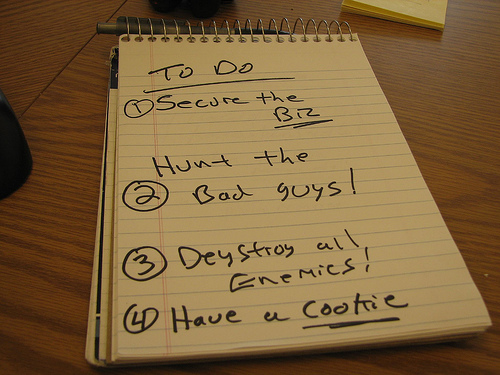
Everyone is familiar with a to-do list, but most people don't really understand the importance of having a list of the things you want to accomplish. Creating a to-do list is creating a list of goals. The list tells you what you need to do to achieve some larger outcome in your life. The power isn't so much in the list itself, but in the overall goal it helps you to achieve. A list is a way to break down your life goals into easy manageable steps that you can complete in a specific amount of time. In this sense, your list becomes a guide showing you how to succeed in life. The way most people start off creating to-do lists, isn't particularly effective. It is easy to end up with … [Read more...] about The Sacred To-do List
100 Personal Outsourcing Ideas
The idea behind personal outsourcing is to free up more of your time by delegating tasks that don't require your personal touch to complete. I've heard of people outsourcing reading to their kids and even arguing with their spouse, but the whole point of personal outsourcing is to free up time from unimportant tasks to focus on family and other things of high importance. In this list we are going to look at 100 different ways you can use an assistant to save you time. Some will work with a virtual as well as an on site assistant, some will only work with on site help. Obviously you need to match the job with the skills of your assistant, but this can provide a valuable starting … [Read more...] about 100 Personal Outsourcing Ideas
Five Time-savers

Logging into and navigating voice mail. Of course, you have to check your voice mail; but there are some things you can do to keep it from interrupting your day. Personally, I find that navigating voicemail menus is a huge waste of time. I have set my voice mail system to send me an email with the message attached as a .wav file whenever someone leaves me a message. This centralizes all my messages to the same place (my email box) and doesn't require that I navigate using the phone keypad. Reading emails. Here are several tips for streamlining your email reading: Make all your emails come to one place. If you have to log into several different accounts to read email you … [Read more...] about Five Time-savers
Productive Airplane Rides

Today I heard an interesting statistic: One hour of work on an airplane is equal to three hours of work in the office. Wow! Sounds incredible, doesn't it? If that is true, then basically, you'd get just as much done if you spent three hours every day on a plane and take the rest of the time off. Offices of highly paid workers would be better off if they would stop leasing expensive floorspace and just get everyone airline tickets every day. Okay, so maybe it doesn't scale to something you can do every day of the week, but if you've ever worked on a long plane ride, this statistic doesn't sound completely unreasonable. Planes offer the following: A bunch of people you probably … [Read more...] about Productive Airplane Rides
How to keep from Wasting Time on the Web
I saw this quote on a mailing list: For personal reasons, I do not browse the web from my computer. (I also have not net connection much of the time.) To look at page I send mail to a demon which runs wget and mails the page back to me. It is very efficient use of my time, but it is slow in real time. -- Richard Stallman Basically, if he wants a page, he sends an email to a special address asking for it and the page is emailed back to him. That is definitely one way to keep from wasting time on the internet. A lot of times the internet doesn't help productivity because it wastes just as much time as it saves. Here are some tips for keeping focused. Block Ads - Ads are there to … [Read more...] about How to keep from Wasting Time on the Web
Stop Squandering Time At Home
Most of us put a good deal of time into running our households. There are always floors to vacuum, bathrooms to clean, and garbage to take out. Other than hiring a maid, there is no way to do away with all these activities. However, a little planning ahead can drastically reduce how much time you spend on some of these activities. This is a list of simple time- and work-saving ideas for your home. Minimize soap scum It seems that soap gets everything clean except shower walls. In your bathroom, soap becomes the dirt you are trying to remove. However, some soaps stick more than others. I recently tried an experiment with different types of soap and noticed a very big difference in the … [Read more...] about Stop Squandering Time At Home
Valuable Activities
When it comes to what you spend, your money on you should focus on things that appreciate instead of things that depreciate. For example, if you buy a house for a fair price, it will generally be worth more in 15 years than what you paid for it. If you purchase a sports car, it will generally be worth less. When it comes to how you spend your time, you have to think in the same way. Some activities are inherently more valuable than others. Activities that make you more valuable or create something that will produce an income for later make for a better use of your time than activities that produce no lasting benefit. A common trait I see in successful people is that what they do for … [Read more...] about Valuable Activities
How to do a Time Audit

There is often a great discrepancy between the way you spend your time and the way you think you spend your time. A time audit helps you look at exactly how your time is being used so you can better understand where your time is going. One form of a time audit is to simply keep a log of your time. This works to a certain extent, but it tends to better show how you want to spend your time instead of how your time is actually spent. For a time audit to be effective, it needs to reflect your actual work history. Here is a simple method for doing a time audit that will help show how your time is actually spent. Get some type of timer that can be set for a specific interval of time. You … [Read more...] about How to do a Time Audit
The Power of Knowing

A lot of time-management techniques suggest creating some sort of prioritized to-do list. Why? What is so special about having a pre-determined order assigned to the things you need to do? Obviously, picking your kids up from school is a bigger priority than washing your car, but for the things that are nearly equal, what does it matter? It turns out that there is a very good reason that so many people recommend this. Good time management has an arch enemy. It isn't interruptions or even procrastination. The big foe to good time management is indecision. Knowing exactly what you need to do next wards off indecision. Even if the order is somewhat arbitrary, there is value in having … [Read more...] about The Power of Knowing
Parking Strategies

I'm amazed at how much time people are willing to spend driving around a parking lot looking for a space to park. I'm not talking about places where it is snowing and there are only limited slots in covered parking. I'm talking about the people who will drive around the lot for 15 minutes trying to avoid a 2 minute walk from the empty spaces just beyond the spots everyone is fighting for. In this post, I want to talk about optimal parking strategies, because people seem to waste so much time on the activity. But first a story: I knew someone who would occasionally go to the mall around Christmas. He would walk toward a car in the prime parking spot and invariably be followed by a … [Read more...] about Parking Strategies
10 Timesavers for Office Workers

If you work in a traditional office, you need specific strategies to help you make the most of your time. This post looks at a number of simple things you can do to save time at work. Most people can easily free up another 15 minutes per day, simply by following a few of these strategies. In the ideal world, your boss would let you cut out early with those 15 minutes you saved, but unfortunately, our society seems to be more focused on how much time you put in rather than value. Even if it doesn't translate into more time away from work, these tips can help you use your time more effectively so you can get more done and out-perform your peers as you advance your career. If you … [Read more...] about 10 Timesavers for Office Workers
The Most for Your Minute

(In this series of posts, we are examining ways to better manage our time.) The Order of Tasks There is a survival simulation where you are trapped in a cave. There is a single ladder going to the surface that can only hold one person at a time. There are two other individuals with you. One is younger than you and can climb faster. The other is older than you and can climb slower. Your job is to decide the order that people should leave the cave--oh I forgot to mention there is water rising and if you don't do it in the correct order, someone will drown. The trick is to send the older person last because they can still be on the ladder climbing as the water covers the area … [Read more...] about The Most for Your Minute
Easier to Buy Than to Use

It is much easier to buy exercise equipment than to use it to get into shape. I'm taking advantage of that right now by creating a home gym of used equipment for about 1/3rd the cost of new. Exercise equipment isn't the only thing that is easier to buy than to really use. It is very easy to become enamored with high-tech devices that promise to save hours of time when we are in the purchasing stage, but fail to execute when it comes to really implementing them. This isn't just a problem for individuals. I routinely see businesses spend hundreds of thousands of dollars on software designed to make them more efficient, only to lose most of the advantages because they don't have the … [Read more...] about Easier to Buy Than to Use
The Most for Your Minute

I still believe that the most productive people are the ones who only do a few things, but do those things very, very well. However, that isn't a luxury most of us have--especially early on in our careers. In this series of posts, we are going to look at ways to better manage our time and get the best return on investment. Time is an Investment Speaking of your return on investment--just thinking of time as an investment can help you become more productive. Changing your mindset about time and seeing it as a currency that you can spend as you choose helps put you in a frame of reference to value time appropriately. When you spend your time, you can spend it in areas where there is a … [Read more...] about The Most for Your Minute
Concentrating with Ambient Sounds

Do you ever have a hard time concentrating because of noisy distractions? Wouldn't it be ideal if you could break out the walls in your office and place your desk 25 or 30 feet away from that noisy employee, grinding printer, or chirping phone? Most of the time, you can't do anything about your physical space and your proximity to noisy distractions. But you can give yourself some sonic space. Just think, if you could take the sound of your co-workers' chitchatting 5 feet away and make it sound like they are 30 feet away. Wouldn't that accomplish pretty much the same thing as physically moving your desk away from them? Do you wish your co-workers had volume controls? You can't turn … [Read more...] about Concentrating with Ambient Sounds
5 Things That Save Me Time

Amazon Prime We live in rural Fort Scott, Kansas and while I like to try to shop local, there is a lot of stuff we need that simply isn't available nearby. Amazon Prime gives me free two day shipping on most of their items. This means I can place an order on Monday afternoon and have it Wednesday. For an extra $3.99 per item I can get it the next day. I've used this to buy everything from books to fruit juicers to network cables. Working from Home Working from home means I don't have to waste any time getting in a car and going somewhere every day. My office is down the hall and down the stairs. Its not that uncommon to find people who are putting 6 hours (or more) into just sitting … [Read more...] about 5 Things That Save Me Time
Important Tasks

Have you ever started a day with some great ideas of everything you want to accomplish, but suddenly it is 6pm and you have nothing to show for your day? While it is probably impossible to keep this from ever happening, we can minimize it by doing something very simple: Do something important first. That isn't really an amazing idea, but it is very very powerful. If you can, early in the day, do one or two things that have lasting value, you'll be taking steps in the right direction--even if the entire rest of the day is shot. The goal of this approach is to make sure you aren't sitting still. You want to make sure you are moving forward, and the best way to do that is to make some … [Read more...] about Important Tasks
Messing with Other People’s Time Management

I write a lot about how to be more productive, but what if that really isn't your thing? What if you don't like productivity? What if your goal in life is to ruin productivity for other people? In an effort to expand our readership to people striving for unproductivity, here are six things you can do to guarantee that your co-workers get as little done as possible. Productivity501 takes no responsibility for the results of actually implementing any of these ideas. Randomly put entries on their calendar like: "1:30 meeting with John White Important!" or "Call Sally 535-321-1242". Place them far enough in the future that they won't suspect you did it. Write in fake delegated … [Read more...] about Messing with Other People’s Time Management
Where Did My Day Go Contest Winner
We have a winner in our most recent contest. Chad Harless won a copy of Where the !@#% did my day go? by Matthew Cornell. I'd encourage you to subscribe to Matt's RSS feed or newsletter for more tips on his time management method. Thank you to everyone who participated. If you'd like your own copy of Where the !@#% did my day go? or his other ebooks checkout his products page. Also … [Read more...] about Where Did My Day Go Contest Winner
Doing Less

A lot of what people write about being productive is centered around doing more. GTD is based on trying to make sure you are able to do more. Most planning systems are based on trying to do more. While I can see the need for this, it is sometimes important to step back and think about what you are really accomplishing. Doing more is only valuable if you are doing things that really need to be done. A system that just enables you to always be busy isn't really valuable. Obviously there is some value in not letting anything "slip through the cracks" if you are talking about things like getting your wife a birthday present or going to your son's soccer game, but letting some things … [Read more...] about Doing Less
Office Timesavers

There are a lot of little things you can do to save yourself time in your office. Each of these ideas can make a modest improvement in the amount of time you save. If you do several of them together, it can start to add up to a serious amount of time savings by streamlining your work. 1. Keep cleaning supplies within easy reach It is a simple thing, but having some Windex and paper towels nearby to wipe down your desk can save you time and help keep your workplace more organized and tidy. 2. Remove your guest chair People are less likely to stay for a long time chatting if there isn't a place to sit. You can keep a fold out chair nearby or borrow a chair from the conference room … [Read more...] about Office Timesavers
Reducing Expenses vs. Being Productive

We usually think of being more productive as a way to make more money, or at least make the same amount of money with less effort. This is a short sighted approach. Being more productive really means doing things that will give you more time to pursue the things that are really important to you. If I am able to maintain my same level of pay and cut my work time in half, I've made some pretty significant improvements in my productivity. But what if, instead of maintaining the same level of pay, we just try to maintain the same standard of living. Or better yet, just maintain the same standard of living on things that are important to us. This type of thinking suddenly opens up … [Read more...] about Reducing Expenses vs. Being Productive
Interview: Productive Time of Day

We interviewed a number of people and asked: What time of day do you feel you are most productive and why? (198) Here are their answers. What about you? Leave your thoughts in the comments. I feel most productive in late morning and early afternoon. My energy peaks at this time of day, and I have found I am able to focus more on important tasks. I am not a morning person, so usually I end up going around in circles or repeating something- basically, wasting my time. Late afternoon, beginning around 3, I begin to get sluggish and often need a nap! It is important to know when your energy level is at its highest and when you are least distractable. That is when you should … [Read more...] about Interview: Productive Time of Day
Take the Time to Play

I have a theory. Since I will probably never have the resources to try to prove it, the next best thing is to share it with readers and see what type of feedback I get. My theory is this: There is a direct relationship between your maximum creative output and the amount and quality of time you spend doing non-work activities. The idea is that you will never reach your full potential for efficiency and productivity without significant investments in non-work, fun activities. If all your time is spent working, you will accomplish less than if you leave some time to relax and pursue recreational activities. I think this only holds true for creative-type work. If you are simply … [Read more...] about Take the Time to Play
The Habit of Lateness

When I was in college, my roommate had a very difficult time getting up in the morning, so he was often running late. To help himself get to class on time, he set his clock ahead about 5 minutes. This worked well for about a week. It took about 7 days for him to get used to the idea that the clock was set ahead, and the method started losing its effectiveness. No big deal. He just bumped it another two minutes forward and he started being on time again...for about a week. I was sitting at my desk reviewing some notes for my next class at 1:50. I stood up to grab a book off the book shelf and something just didn't seem right. It took me a minute to realize that I had seen a … [Read more...] about The Habit of Lateness
Measure and Notice your Progress

You can only improve what you notice and you can only notice what you measure. If you want to improve some area of your life or work, you have to be able to measure it. Without some way to gauge your progress, you won't know if you are making improvement or not. For example, when I was running the technical department at a large non-profit corporation, I started measuring our response time for help desk tickets. This was quantifiable data, and by looking at the trends over time, we were able to see if our response time was improving (going down) or getting worse (going up). Without measuring this, we would of had no objective way to measure our performance and we would have been … [Read more...] about Measure and Notice your Progress
Your Own Business

In a previous post I mentioned that if you are the type of person who focuses on personal productivity, you probably shouldn't be working for someone else. I wanted to explain why. Many people focus on being highly productive, but no one seems to talk about how to actually benefit from being more productive. Sure you can make your boss really like you, but just because you are helping your employer be more efficient doesn't mean you are going to see any personal benefit--other than being well liked. How Businesses Make Money Businesses make money by selling items or services for more than it costs them to produce those items or services. The dry cleaner may charge you $2.00 per … [Read more...] about Your Own Business
Collegiate Time Management

College is one of the most exciting and activity-filled times of a person's life. Making new friends, developing new skills, and shouldering many more responsibilities take up a lot of time, let alone the ever-present studying that needs to be done. Time management is so important for students that many Freshman Experience classes focus on the subject. Here are a few tips to help busy students make good use of their time. 1. Plan ahead Studying in college requires more preparation than one might think. With all of the other distractions that are available, it is important to plan out a study schedule and really stick with it. That way, you will already have your studying done when your … [Read more...] about Collegiate Time Management
Internet–Friend or Foe for Productivity?

The internet is a valuable tool that can let us do things faster than anything we imagined 20 years ago. But at the same time it can be a very big time waster. The internet is kind of like a dictionary with beautiful illustrated pictures. It is wonderful to look at, but it can take 10 times longer to actually do anything up because of all the amazing (and distracting) pictures: Lets see how do you spell "artichoke"....neat here is a nice little drawing of an airplane...wait what was I...oh yeah "artichoke" ok that will be a little further...what is that a picture of?....oh an anteater. I didn't realize their noses were so long. Ok now focus...."artichoke". Hm. How do they know what … [Read more...] about Internet–Friend or Foe for Productivity?
5 Exercise Tips for Busy People

A normal day for most busy people consists of a constant string of tasks: go to work, get the kids ready for school, unload the dishwasher, mow the lawn, etc. The problem is, there isn't any room in the day for exercise! At least, it seems so. Students in college, professors, businessmen and women, and others from all fields of work often confront this same dilemma. There are many pressures on how we spend our bit of free time. However, the quality of the exercise done often trumps the quantity of it. Here are some ways to get the most out of your few minutes of exercise time. 1. Take a walk If you have few options, taking a 10-15 minute walk over your lunch break is a nice way to … [Read more...] about 5 Exercise Tips for Busy People
Redeeming Your Time

Whether you run a home business or simply want to be more productive with your time each day, time tracking tools are a technological aid that can diagnose tasks that are efficient and those that are not worth the time invested in them. The time tracking tools that are available today are customized to suite different needs and preferences and help make productivity an achievable goal. We thought that our readers would find a list of time tracking tools useful, as well as a bit of information about each one. Rescue Time This tool offers time tracking service in a neatly organized package that is easy to install and operate. Rescue Time works by tracking which applications the user … [Read more...] about Redeeming Your Time
Standing on Shoulders of Giants

You've probably read the quote from Isaac Newton: If I have seen further, it is by standing on the shoulders of Giants. The idea is that we can leverage the work of people before us in order to do things that wouldn't be possible on our own. If you want to create a new type of time-saving computer application, you don' t have to start with inventing a computer. You don't even need to completely understand how a computer works in order to leverage it for your success. Learning to use the results, accomplishments, and skills of others doesn't always come naturally. While you might not be tempted to reinvent the computer, it can be very easy to overlook the input from your friends and … [Read more...] about Standing on Shoulders of Giants
Keep People from wasting your time

I'm sure everyone has been in situations where a coworker is wasting your time, but there doesn't seem to be a polite way out of it. Here are several simple strategies for keeping your distractions to a minimum without appearing impolite or rude. Stand - By standing when someone walks into your office, you will usually prevent them from taking a seat. This can help keep them focused on the purpose of their visit and getting back to work (where they can sit again). Meet them at the door - If you see someone about to come into your office, meeting them at the door puts you physically between them and your area. You are being polite because you've walked toward them to meet them, but … [Read more...] about Keep People from wasting your time
Define and Conquer

There was an interesting experiment done by the American Pulpwood Association when they were looking to increase the productivity of loggers. Half of the loggers were given a specific, high goal to achieve. The other half were encouraged to do their best. The people who were assigned goals started bragging to one another as well as to family members as to their effectiveness as loggers. Productivity soared relative to those crews who were urged to do their best. Goal-setting instilled purpose, challenge, and meaning into what had been perceived previously as a tedious and physically tiresome task. A by-product of the goal intervention was that, within the week, employee attendance … [Read more...] about Define and Conquer
The Zone

There are two things that will impact how much you get done. First, there is the amount of time you spend. Obviously, you can get more done in 20 minutes than in 2. The second is how focused you are. This factor is referred to as, being in "the zone". When it comes to your personal productivity, the second factor is usually more important than the first. How many times have you spent 30 minutes working on a task that you didn't really want to do and made very little progress, but when you truly decide you want to complete that task it only takes 15 minutes? This a common occurrence for most people. Often the biggest differentiator between highly productive and less productive people … [Read more...] about The Zone
Telecommuting From Home

This post is a series of links I asked my assistant in India to compile and summarize on telecommuting. With skyrocketing gas prices, now is a good time to consider telecommuting. You can even approach your boss about doing it to help the environment. (We've previously written about how to approach your boss about telecommuting.) Ever Given a Thought to Telecommuting? - Vishal P. Rao Should you be confused about telecommuting, this article acts as an eye-opener. Starting with a perfect definition of the term, the article also gives the advantage and the steps that can eliminate the drawbacks involved. The author also provides a link to gain additional knowledge and help you get … [Read more...] about Telecommuting From Home
Procrastination Prevention Course – Now Live!

Previously I announced that we were testing the Procrastination Prevention Course. I took the feedback from the testing group and made some changes. The course is now live. If you have trouble with procrastination, you need to go through this course. It is designed to give you some simple strategies for preventing procrastination. Each day you get a short email with a simple assignment to help you practice breaking the procrastination habit. The funny thing about a procrastination course is that the people who most need it are the ones most likely to put it off. If you are reading this and thinking "Maybe I'll do that some day" I strongly recommend that you sign up for it right … [Read more...] about Procrastination Prevention Course – Now Live!
The Promise of Sleep — Book
Sometimes we focus on the wrong things. For example, it is easy to focus on trying to do more during the day while short changing our sleep at night. This book looks at how and why we sleep. It is based on a lot of sleep research, but the writing style is very accessible and makes for an interesting read. For example, the author explores the right balance of sleep to let you fall asleep quickly and wake up without feeling worn out. He talks about situations where people sleep too much and then suffer from insomnia until their body gets tired enough to fall asleep again. One of the more interesting concepts in the book is the idea of a "sleep debt". This theory basically says … [Read more...] about The Promise of Sleep — Book
Reader Question – Uncompleted Tasks
I've been an avid enthusiast (not to say follower) of GTD and productivity blogs in general. (This one has long been chief on that list; keep up the good material without diluting it.) Currently I just started a new role at work where I have a bit more responsibility.To keep track, I've been using tasks--via Outlook 2007 and Remember the Milk. Both are great ways to quickly catalog things to be done. However, the other side of my job is that I can get "interrupted" with urgent things that legitimately take precedence over my (usually) non-urgent tasks. So days can go by without me getting any tasks completed. This feels pretty crummy. What do I do with that? Any mentality tips you can … [Read more...] about Reader Question – Uncompleted Tasks
Doing Less

Time management usually concentrates on doing more with your time. At least once in awhile, we should concentrate on doing less. Over time we tend to acquire a bunch of baggage of things we feel we need to do. By eliminating some of our current activities, we can increase the amount of time we have available to concentrate on the things that are really important to us. The approach of the new year gives us all a great opportunity to prune activities from our schedule. By taking a few moments to re-evaluate the ways we currently spend our time, it is likely that we can identify at least a few items that don't really need to be maintained. Here are some questions that you should … [Read more...] about Doing Less
Work vs. Time

A great deal of productivity is lost because people focus on time instead of work. It isn't the amount of time spent on a task that matters--it is the amount of work that is accomplished. Unfortunately, time is often the easiest thing to measure. Because it is easy to measure, most people are paid for their time instead of what they actually accomplish. Of course, in some rough way, time does translate into work. You can usually get more done in 2 hours than you can in 1, but the time element isn't where the focus should be. It is easy to spend 2 hours without really accomplishing anything significant. When we are focused on time instead of work, we tend to do the tasks that … [Read more...] about Work vs. Time