
With knowledge of our country's current economic situation being broadcast ubiquitously across the news, it is hard to ignore the fact that the economy is slowing down. Jobs that seemed secure are now not so solid, and many employers are beginning to cut costs in any possible way they can. Unfortunately, one of the top trends seems to be downsizing with regard to personnel. Though it is always hard to deal with layoffs, there are ways to prepare for one and devise a strategic plan in case the worst happens. Recognizing the signs Though it may not always be the case, sometimes employers give unintentional information about who they are going to have to let go. Here are a few that … [Read more...] about Layoff Preparation
Archives for March 2009
An Economist’s View of College

Many high school students leave their hometowns with bright ideas and big dreams about what they will do in and after college. For most Americans, a bachelor's degree in a solid field is a worthy goal. Being a college student, myself, I often hear students talking about how wonderful post-college finances will be and how wonderful it will be to drive a reliable, new car and eat real food again. However, since the current economic situation is a bit bleak, tuition costs are under the constant scrutiny of parents and students that working their way through college. SmartMoney produced a study discussed in an article that analyzes the actual return on getting an education. Bargains vs. … [Read more...] about An Economist’s View of College
The Power of Paper

Everyone has their favorite and least favorite tools. For example, I love my computer, but tend to despise fax machines. Today, I had a bunch of work to do that would have been much easier with a fax machine. I managed to do everything I needed using a scanner and email, but I was finally forced to admit that there is still room for a fax machine in my tool set. I still don't really like fax machines, but sometimes it is the perfect tool for the job. Today, I felt like I was using a screwdriver to drive nails--sure, the nail will go in eventually, but a hammer is really what you need. It would be silly to decide that I don't like hammers, so I'm going to use a screwdriver, but I've … [Read more...] about The Power of Paper
Cutting Out Distractions

I once heard a story about an author who had designed a house especially to be used for writing. The house was built on a mountain and had an impressive view of the valley and mountains beyond. The author had designed an office especially for writing. It had large windows overlooking the gorgeous view. Facing the windows was an expansive desk where the author planned to write many books. However, there was just one problem. After moving into the house, the author discovered that he couldn't get any work done. He would sit at his desk overlooking the gorgeous view, but he just couldn't concentrate. It turned out that the view wasn't inspiring him. It was just a … [Read more...] about Cutting Out Distractions
Freelance Switch Article
I have an article that was published over at Freelance Switch called: Nine Steps Toward Genuine & Effective Networking. How many of the nine steps are you are doing? … [Read more...] about Freelance Switch Article
Outsourcing Ideas
Sid Savara has some excellent suggestions for hiring a cook/chef via Craigslist. Sacha Chua has a review of TimeSvr and oDesk for Virtual Assistant work and a list of tasks she has assigned to TimeSvr. … [Read more...] about Outsourcing Ideas
Fruitful Time Business Edition
Fruitful Time makes a free Productivity Meter that we've mentioned before. It tracks how your computer is being used and gives you a good idea how your time is being spent. They now have a paid Business Edition that lets you do the same thing for a group of employees. I have used some tools like this in the past so my staff could tell where they are spending their time. It looks like it is still windows only. For a cross platform (OSX and Windows) tool, check out Slife. They make a similar free personal/paid team product. If you are looking at a product like this, one of the big things you want is the ability to track things based on the path or name of the document being used. So … [Read more...] about Fruitful Time Business Edition
Tips for Taxes
Here is a round up of useful tax tips as we get into the tax filing season. IRS Presents-Top Ten Tax Time Tips - This article explains some time saving measures that can help the filing process be more efficient and streamlined. 3 New Tax Changes - These tips could be useful for those that haven't yet taken a look at the recent changes in filing taxes. 6 Tax Tips for Tough Times - The advice in this article may be especially helpful for those that have recently lost jobs or other sources of income. Tax Tips for Small Businesses - This article contains money-saving information particularly relevant for small businesses. Retiring: Tax Tips - For those that have reached retirement … [Read more...] about Tips for Taxes
Experience Better than Possessions
CNN has an article about how experiences with others brings more happiness than buying material possession. It is worth reading--particularly in a time when a lot of people are stretching their dollars. Focusing on obtaining happiness can be a lot less expensive than focusing on obtaining stuff. (via FMF) … [Read more...] about Experience Better than Possessions
$8,000 To Buy a House
If you live in the US and haven't owned a house in the last 3 years, the government will give you up to $8,000 if you buy one in 2009. The money is a refundable tax credit, which means you get it even if you owe no taxes in 2009. This shouldn't be your only reason to buy, but it is worth keeping in mind. … [Read more...] about $8,000 To Buy a House
Facebook Fan Page
Productivity501 has a Facebook Fan Page. If you are a Facebook user, we'd love to have you as a fan. … [Read more...] about Facebook Fan Page
Google Voice
Grand Central is becoming Google Voice. While it isn't open for the public just yet, it is a step closer. If you have a Grand Central account you can convert it to Google Voice. There are a quite a few new features. Some of the big ones are: Voicemail transcription, free outgoing (and incoming) calls, and SMS messaging. It sounds like they are looking at adding the ability to port numbers into Google Voice in the future. This could be a very big deal. You could move your main number into Google Voice and then have it ring whatever numbers you want. … [Read more...] about Google Voice
Couple’s Finances
Money can be one of the biggest strains on relationship. Many couples are at odds financially and when things get tight, the relationship suffers. With the current state of the economy, now is probably a good time to review this older post on working together financially. Any investment you make in your relationships are going to have much higher returns than the stock market. … [Read more...] about Couple’s Finances
Two Links for Managers
Do your employees have a "day job"? talks about how to keep your employees from seeing their job as something they do just to pay the bills. The Definition of Management looks at a number of management definitions and discusses how those may influence your role as a manager. … [Read more...] about Two Links for Managers
The Habit of Lateness

When I was in college, my roommate had a very difficult time getting up in the morning, so he was often running late. To help himself get to class on time, he set his clock ahead about 5 minutes. This worked well for about a week. It took about 7 days for him to get used to the idea that the clock was set ahead, and the method started losing its effectiveness. No big deal. He just bumped it another two minutes forward and he started being on time again...for about a week. I was sitting at my desk reviewing some notes for my next class at 1:50. I stood up to grab a book off the book shelf and something just didn't seem right. It took me a minute to realize that I had seen a … [Read more...] about The Habit of Lateness
Lotus Symphony Review
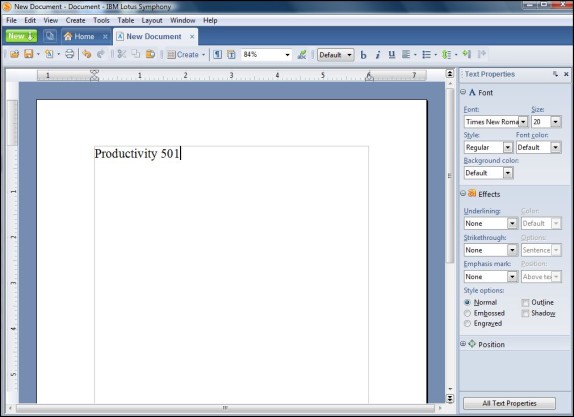
Most people have heard the expression, "There is no free lunch." While this may be true in some situations, it isn't always true in the realm of application software. Desktop publishing is one area where there are not a whole lot of alternatives. Microsoft hold the biggest share of the market, by far. However, IBM has come up with a free product called Symphony, which includes capabilities similar to a Microsoft Office Suite. Although the two programs are similar, they are, by no means, mirror images of each other. First Impressions Though the Microsoft Office Suite has just undergone a major update, some find the new layout a bit more confusing than they did the old. The word … [Read more...] about Lotus Symphony Review
Tax Tips Link
Here are a list of tax tips for entrepreneurs from a number of people, including me. Don't forget, April 15th is coming up soon. … [Read more...] about Tax Tips Link
Authoritative Jaywalkers
Did you know people are 3.5 times more likely to follow a jaywalker's lead in crossing the street when the jaywalker is wearing a business suit? The way you dress heavily influences how people perceive your authority. … [Read more...] about Authoritative Jaywalkers
Vote for Best Answers
Please take a few minutes to vote for the best answers. Your input helps determine the order that interview answers are published. Simply select a question and then vote for the answer in the pair that you think is the best. … [Read more...] about Vote for Best Answers
NomaDesk Review

Recently at Productivity 501, we have taken a look at several different tools intended for file sharing. All of these products shared the attribute of being available for both business and personal use, although some were better suited to one than the other. One additional file sharing tool that came to our attention is NomaDesk, the flagship product of the Belgian start-up Aventiv. Thought most file sharing software is developed with the average businessperson's needs in mind, NomaDesk was created specifically for someone who is constantly "on the run." Those that work from many different locations and from laptop computers know precisely what the challenges are for mobile … [Read more...] about NomaDesk Review
Personal Development: Reading Habits

Most people are not suffering from a lack of things to read. For many people the difficulty is deciding what not to read as there are so many choices available. To get some ideas how people prioritize and choose reading materials, we asked a number of bloggers the following question: What are your reading habits and how do you choose reading material when there are so many options? Here are their answers. (4005) I come across a website through some means or another, and if I like it, it goes in my feed reader. If it hasn't got a feed, I'll probably never come back. But the bulk of my reading is books, and my choices are usually informed by recommendations from friends or … [Read more...] about Personal Development: Reading Habits
Free Tax Preparation Software
If you have a simple tax return, you can file for free at TurboTax and H&R Block. The IRS also has a list of places where you can file for free and free online forms that do basic calculations for you. You still have to pay to do the state return. … [Read more...] about Free Tax Preparation Software
Higher End Scanners
If you are looking for a higher end scanner than the ScanSnap, check out Fujitsu's fi-6000 series. They are network scanners designed for a small office and look like they offer many of the ScanSnap-type features without being tied to a single PC. … [Read more...] about Higher End Scanners
Measure and Notice your Progress
You can only improve what you notice and you can only notice what you measure. If you want to improve some area of your life or work, you have to be able to measure it. Without some way to gauge your progress, you won't know if you are making improvement or not. For example, when I was running the technical department at a large non-profit corporation, I started measuring our response time for help desk tickets. This was quantifiable data, and by looking at the trends over time, we were able to see if our response time was improving (going down) or getting worse (going up). Without measuring this, we would of had no objective way to measure our performance and we would have been … [Read more...] about Measure and Notice your Progress
Behaving in Court
Lawyer Andrew Flusche has some recommendations on how to behave in court based on what he sees people doing in Virginia Traffic Court. You would think people would know better than to show up while chewing gum, but evidently not. His advice is good for pretty much any situation where you need to make a good impression on someone in authority. … [Read more...] about Behaving in Court
Dealing with Gadgets

I have to admit, I'm a gadget lover. I like playing with phones, cameras, personal organizers and all kinds of electronic devices. I'm not quite as much an addict as I used to be, but I still like mobile electronics. Some of these gadgets can be really big time savers and a good investment. Other gadgets are great fun to use, but the time they save is offset by the time they cost. Then there are the gadgets that make you think you are being more productive, but actually make you waste time. Here are some of the things that I look for in a gadget to help make me more productive: Better Use of Downtime – Everyone spends time waiting for planes, waiting for appointments, driving in … [Read more...] about Dealing with Gadgets
Scientists and Magicians

In an interesting experiment, scientists showed individuals photos of two female faces and asked them to pick which one was more attractive. Then using a slight of hand trick learned from magicians, the scientist replaced the chosen photo with the one that was not chosen. So, the individual was handed the photo that they had decided was less attractive. Only 26% noticed the switch. The other 74% accepted the rejected picture as the one that they had chosen. Now possibly that could be explained by saying that they just weren't paying attention to the photo once it was handed to them, but the scientists went one step further. After handing over the photo, they asked the individual … [Read more...] about Scientists and Magicians
Using a Digital Signature?
I'm curious how many readers are using digital signatures. If you use a digital signature, please take a moment to leave a comment letting me know what you use and why you use it. … [Read more...] about Using a Digital Signature?
Brain Rules

I was sent a copy of Brain Rules: 12 Principles for Surviving and Thriving at Work, Home, and School to review and I must say it has been a very interesting read. The author, John Medina, is a developmental molecular biologist. He has written a surprisingly accessible book on how the brain works full of tips for getting the most out of your mind. The book is broken down into 12 rules. Here are a few: Exercise - One of the biggest contributors to a clear mind as we age is exercise. Our brains are only 2% of our body weight, but require 20% of our total energy. Exercise helps improve circulation and moves more oxygen to the brain. The book suggests that conducting meetings while … [Read more...] about Brain Rules
Not Because it is Easy

John Kennedy said we were going to go to the moon "Not because it is easy, but because it is hard." The Apollo 11 mission was a huge success and really brought the nation, and to some extent, the whole world together around a scientific adventure. Choosing to do something because it is difficult is a great way to grow. If you truly want to extend your capabilities, you have to do things that are hard. You have to do things where you might fail. If you only attempt to do the things you've done before, you might have some level of growth but nothing compared to what you are capable of. The problem comes when people fail. Most individuals don't know how to handle failure. It knocks … [Read more...] about Not Because it is Easy
Kindle Books on iPhone
Amazon has an app that will let you read your Kindle ebooks on an iPhone or iPod touch. This is actually a pretty big deal as it allows you to view the same book on multiple devices and keep your current page synced. … [Read more...] about Kindle Books on iPhone
Effective Web Browsing

Most people have a collection of sites that they like to check every few days. Unfortunately, checking a few sites can turn into several hours of pointless surfing without any real benefit. Here are some strategies that will let you maximize your productivity while using the web to stay up to date. Set aside time to visit your favorite sites. If you don't create space for it, you'll end up opening your browser everytime you are faced with a task that you want to procrastinate on. Avoid this by setting up a specific time. This can be in the morning before going to work, at lunch time, in the evening. It doesn't matter when it is, but set up a time and get into a schedule. Set a … [Read more...] about Effective Web Browsing
Turkeys and Skunks

Turkeys don't like skunks. Skunks like turkeys, but mainly because they can eat the baby chicks. So it isn't surprising that when a skunk comes around, a mother turkey will attack it to keep it away from her babies. Here is another fact about turkey mothers. They respond to their chicks saying "cheep cheep". If the chick says "cheep cheep" the mother will care for it. No "cheep cheep" and the mother will ignore it and sometimes even kill it. So if you are a baby chick, the "cheep cheep" is very important. In a slightly bizarre experiment, scientists rigged a stuffed skunk and sent it toward a mother turkey. Ask expected, the turkey attacked the stuffed skunk with her claws … [Read more...] about Turkeys and Skunks
Relenta Review
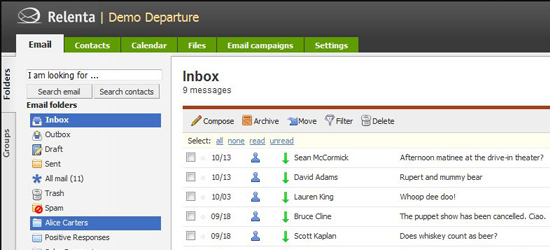
During the course of a day, many of us find ourselves using to-do lists and other means of getting thoughts and tasks out of our minds and into a trusted place of reference. For a business, keeping employees aware of tasks and duties in an organized fashion can be a challenge. From a customer service point of view, making sure that a customer is not overlooked is certainly very important. Since much of the communication in the business world is done through email, companies are finding that it is difficult to consolidate communications so that everyone is "in the loop." Relenta CEO Dmitri Eroshenko states that, "Relenta keeps everyone on the same page...literally." And the software does just … [Read more...] about Relenta Review