If you are really focused on expanding your capabilities, your salary is probably a secondary motivation when it comes to employment. Your major motivation is going to be your learning and growth opportunities. The graph below shows how learning opportunities change over time.
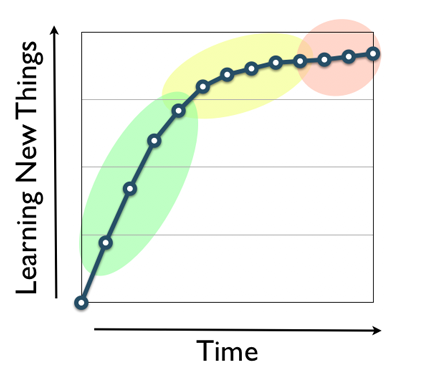
At the beginning of any job, you will have many opportunities to learn because everything is new. This section is marked by the green zone. Every day will involve new experiences and learning new things. As time goes on, this tends to level out, as shown by the yellow zone. Sometimes the yellow zone is only temporary and you will be given new responsibilities that will have new learning opportunities–you’ll basically start the cycle over again.
If this doesn’t happen and you remain at a reduced learning rate for a period of time, you’ll move into the red zone. The red zone is particularly dangerous because it means you are becoming accustomed to a lack of personal growth and a lack of challenges. If you stay in this zone for too long, you will actually reduce your capabilities to take on challenging assignments.
So when should you look for a new job? While you are in the green zone, you will be facing a lot of challenges. Some of these will be difficult and sometimes you might even fail. This is not an indication that you should move on. It means you are still growing. One mistake I see people make is leaving jobs where they are still learning just because it isn’t easy.
When you get into the yellow zone, it is time to start re-evaluating things. You need to honestly access the chances of getting different responsibilities that would move you back into the green zone. You also must consider your potential for salary growth. If you are at the high end of the pay scale, continued growth may not translated into growth in pay. When you get to the yellow zone, you may need to sit down with your employer and talk about your future at the company to get a feel for what opportunities might become available if you stick around.
Even if your employer doesn’t have any new or challenging projects, the yellow zone can be a good place to try to take advantage of any educational opportunities. If your employer offers tuition reimbursement, you might look at working on an advanced degree. Sometimes additional education will help give you a new way of looking at your current job and open your eyes to opportunities for improvement that your employer may not think to ask for.
At a previous employer, I had been in the yellow zone for about a year. I had already used the educational benefits to do most of the coursework I needed for a second master’s degree. Finally I sat down with my boss and asked, “What are the new challenges I’m going to get to experience in the next 6 months?” He told me that there wasn’t really anything they wanted me to do other than just keep things running the way they were. A few days later, I submitted my resignation. For me, the challenge was getting things to the point where my department was running smoothly. Simply maintaining the status quo would have been easy. The organization was pretty flexible with work schedules as long as things were getting done, so simply maintaining things would have translated into a lot of free time for me. The idea of not having new challenges scared me because I looked around and saw a number of other employees who were basically on cruise control. They had nice non-stressful jobs, but it had been years since they had ever attempted anything challenging. My fear was that I would become like that.
I took a job with another company where I figured I had about a 60% chance of being able to be successful and a 40% chance of failing horribly. The first few months were extremely difficult, but I learned a tremendous amount. More importantly, I raised the bar on what I was capable of doing. This experience has served me well. There are many small and large successes I’ve had in life that I can directly trace back to the decision to leave the easy job and take one that would challenge me.
What work zone are you in? How long are you comfortable staying there?
I’ve been dangerously far into the red zone at my current job. Fortunately, I got a new one and will be starting soon. Can’t wait for the green zone again.
Great metaphor!
@Jennifer – Good luck with your new job! I’m glad you liked the chart.
Going into the high yellow or the red once in a while might not be an entirely bad idea as you could use the low activity to carefully chalk out the next stage of your life. The trick would be not too get too settled into the easy going way of life and get de-energized as a result.
Wow, this is an excellent way of presenting this concept. I’ve been thinking about challenge and stagnation recently…I find myself in the red more and more these days..and I know it’s time for a change.
Thanks for sharing this.
While I realize that this is far from a new post, *I* just found it today (and just found the site yesterday). This is probably the single best expression of this concept I’ve seen or heard. I’ll definitely be passing it along.
I’ve been looking for a way to explain just what it is about my cushy job that just barely manages to keep me awake, let alone excited. I’m an unhappy resident in the Red Zone and now realize that some moving and shaking IS just what the doctor ordered.
@Jay – I’m glad you found it useful. I know it was a break through for me when I finally sat down and charted out where I was in my current job. (I quit and started a business on my own.)
Mark,
This is a great visualization of a problem many of us face. Unfortunately, one of the big issues with changing jobs is the benefit package. I often find myself in the red zone but the uncertainty of health insurance always tends to be a deterrent to change.
John
I am somewhere in the yellow zone. Being the only IT person in my company, sometimes the fires introduce a challenge, but there are not too many of them anymore either.
I am not sure what avenue I would like to go down… I like the company I work for, but am not sure that I can grow much more in this role… even though there is not much out there (likely because I am not sure what I want to do).
I wonder if spending some time learning something new on my own would help…?
@Derek – If you are at a small company you may be able to suggest projects that will help the business while challenging you. If you can find ways to make what you currently do more efficient it will likely turn into a learning experience and give you more time for other projects in the future.
I am currently in the Yellow/Red Zone and at the top of the pay scale. However, with the current economy and layoffs finding challenging new roles without risking financial ruin (single income family) or losing medical coverage ( supplies for Type 1 diabetes are expensive and I need them to stay alive) is something I am not ready for.
@Khürt – Good point. Now may not be the best time to jump jobs if you don’t have a bit of a cushion built up. However as a lot of places cut back, there are often ways you can up your responsibility at your current employer to get some new experiences while making yourself more valuable.
This holds true for the low-end manufacturing jobs as well as the “professional” jobs. I was at a company for five years (as a temporary worker) and was stagnant in my job. It was bad enough that when I was released (terminated), I was actually happy.
Now, I’m in a harder job but it’s good because I’m back in the green zone. So it’s not just professionals but everyone. If you’re in a position where you’re in charge of the blue-collar workers, you may want to consider encouraging them to get back into their green zones.
I wanted to add that this post also helped me to reevaluate my feelings towards my new job. I’m still learning how to do it, so it’s ok to have failures once in a while.
Have a great day:)
Patrick.
This illustrates a difference between salaried employees and independent contractors. Employees are far more likely to establish “red zone” positions once mastering the roles and responsibilities of their main job.
But for independent contractors, each new contract presents the “green zone” environment, where the needs and requirements of the contract vary from company to company. The core work might be similar, but the variety in contract work is likely to keep the individual challenged for a much longer period of time.
Lastly, I discovered and followed you last week and enjoy your tweets and posts.
Hi there! Great article!
I hate to admit but I’ve been in the red zone for many years. I work for the Brazilian government so besides benefits (health and dental plan, yearly salary raise, etc), we have stability for life. I didn’t really know what was that when I got this job. But after a while, when I reached the red zone, I realized how much I wanted to be out there, working for a private company, in a daily fight for improving services, creating new products…
Staying in the red zone is killing my time and I’m afraid also killing my potential…