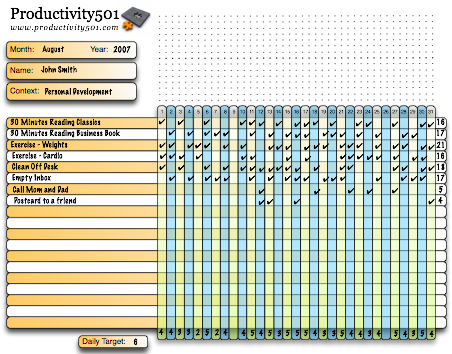
We've had some great response to the Habit List post. Here are several usage ideas for the Habit List: Negative Items - If there is something you are trying not to do, you can add it to the list as negative item. For example, "Didn't watch TV" could be one of the items on the list. Different Lists for Different Places - Part of the idea of the Habit List is to let you focus on your tasks with habit type items out of the way. If your habit list gets long, you might want to use different lists separated by where you will use them. For example, you might have one list for exercise, another list for work, and a third for your home stuff. Teaching Your Kids - The Habit List also … [Read more...] about 8 Habit List Usage Ideas
tasks
The Sacred To-do List
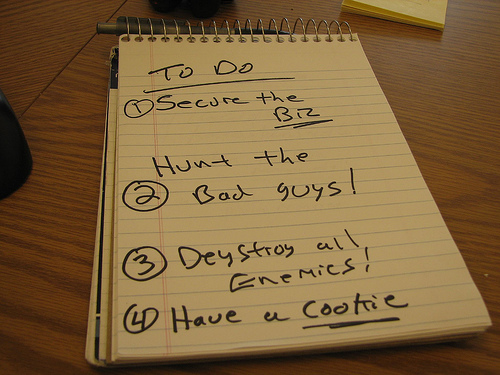
Everyone is familiar with a to-do list, but most people don't really understand the importance of having a list of the things you want to accomplish. Creating a to-do list is creating a list of goals. The list tells you what you need to do to achieve some larger outcome in your life. The power isn't so much in the list itself, but in the overall goal it helps you to achieve. A list is a way to break down your life goals into easy manageable steps that you can complete in a specific amount of time. In this sense, your list becomes a guide showing you how to succeed in life. The way most people start off creating to-do lists, isn't particularly effective. It is easy to end up with … [Read more...] about The Sacred To-do List
Übernote Review
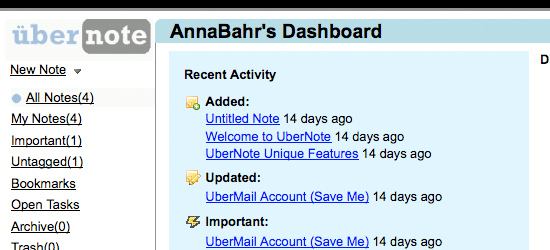
Within the past few years, developers have flooded the web with task management/note taking applications. Most of them are free (for entry-level versions) and most have the same basic idea behind them. However, each one is tailored to a certain niche. Evernote, for example, is a great catch-all device. Its full featured interface is great for large tasks and project management. Ubernote is in a different category in that it is more similar to Springpad, but Springpad is newer, and the interface is much more polished. Potential users should note that Ubernote is an older product, and the user interface reflects that fact. It is free, though. From what I understand, at the time when … [Read more...] about Übernote Review
The Most for Your Minute

(In this series of posts, we are examining ways to better manage our time.) The Order of Tasks There is a survival simulation where you are trapped in a cave. There is a single ladder going to the surface that can only hold one person at a time. There are two other individuals with you. One is younger than you and can climb faster. The other is older than you and can climb slower. Your job is to decide the order that people should leave the cave--oh I forgot to mention there is water rising and if you don't do it in the correct order, someone will drown. The trick is to send the older person last because they can still be on the ladder climbing as the water covers the area … [Read more...] about The Most for Your Minute
Important Tasks

Have you ever started a day with some great ideas of everything you want to accomplish, but suddenly it is 6pm and you have nothing to show for your day? While it is probably impossible to keep this from ever happening, we can minimize it by doing something very simple: Do something important first. That isn't really an amazing idea, but it is very very powerful. If you can, early in the day, do one or two things that have lasting value, you'll be taking steps in the right direction--even if the entire rest of the day is shot. The goal of this approach is to make sure you aren't sitting still. You want to make sure you are moving forward, and the best way to do that is to make some … [Read more...] about Important Tasks
That Looks Easy!

This weekend, my brother-in-law graciously offered to tile our bathroom. He does this for a living, so he is naturally very good at it. I, on the other hand, do not, and am naturally very, very bad at it. What struck me as amazing is how easily he came in, looked at the bathroom, came up with an optimal placement and started on it. It looked pretty easy. Later, he was marking the tiles that needed to be cut and handing them to me to cut on the tile saw. He would hold the tile one way, make a mark, hold it another, make a mark and then use a square to draw a line showing me where to cut it. Simple. Not really. I tried my hand at marking the tile while he made some complicated … [Read more...] about That Looks Easy!
Habit List
As we enter the period of New Year's resolution, I wanted to republish the Habit List which is my most powerful tool in developing new habits. Happy New Year! Note: The PDF mentioned in this post is now available as part of the Habit List Course. You can enroll using the form below: Name: Email: Earlier I talked about the "Habit List" I've been using. I wanted to walk people through the tool and show you how it works in this post. First lets revisit the theory behind it. This tool was created with the premise that "habit" type tasks should not be on our regular todo list. There are several reasons that keeping these types of items on … [Read more...] about Habit List
Fruitful Time
Gaetano sent me a link to screen shots of his companies application FruitfulTime. It is a windows based task management system. … [Read more...] about Fruitful Time
Tuesday’s Tip: Dry Erase Marker
Dry erase markers are wonderful inventions. Not only can you use them to write on the special dry erase boards, but they also work well on glass. You can use this to leave notes in some pretty interesting places. For example, you can write notes on your bathroom mirror where you will be sure to see it in the morning. The window in your office can also serve as a nice impromptu whiteboard. I have a large desk made from a thick sheet of glass over a frame, so I can use dry erase markers to write directly on my desktop. Obviously, having everything you write in a neat wooden framed whiteboard is less messy and looks more organized, but sometimes doing something out of the ordinary is … [Read more...] about Tuesday’s Tip: Dry Erase Marker
Two Task Lists
Franklin Covey (formerly Franklin Quest) training teaches you to keep all of your to-do items in one place. I don't think this is the best approach. I think it is important to separate your important todo items from your list of "habit" type tasks. For example, if I have a to-do item of paying my taxes, it doesn't seem that this should be on the same list as exercise. If I miss a day of exercise, it isn't a big deal. In fact I expect to miss a few days of exercise here and there. However, paying my taxes isn't one of those things I can miss. It should be on my list of things that absolutely have to get done. Exercise and things like that are more of habits that I want to practice … [Read more...] about Two Task Lists